
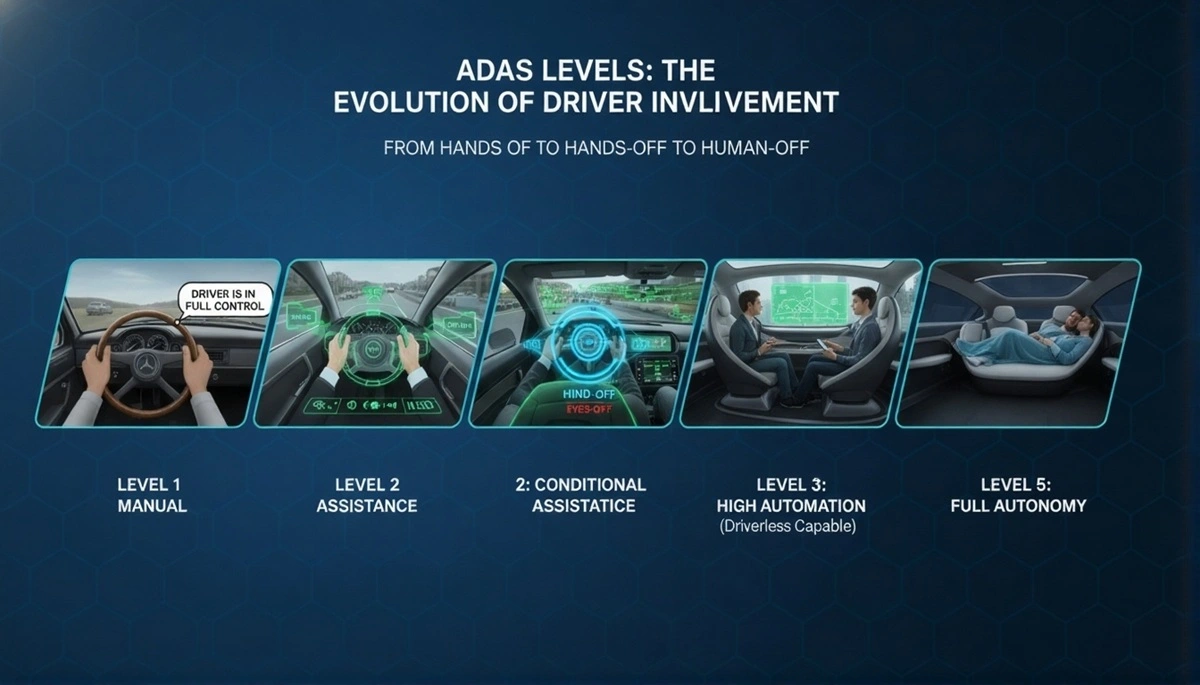

I was driving home late one night on the highway when my eyes started getting heavy. Just as I began drifting slightly out of my lane, a sharp beep jolted me awake, and the steering wheel gently corrected itself. That lane-keeping assist saved me from what could’ve been a nasty accident. That moment made me wonder, what level of ADAS does my car actually have, and how smart is it really?
If you’ve ever been confused about ADAS levels or wondered whether your car has Level 1, Level 2, or something more advanced, you’re not alone. With terms like partial automation and conditional automation being thrown around, it’s easy to feel lost. In this guide, I’ll break down ADAS Levels 0 to 5 in plain English, show you real-world examples, and help you figure out exactly what your car is capable of.
What is ADAS and Why Does It Matter?
ADAS stands for Advanced Driver Assistance Systems. These are smart technologies built into modern cars to help you drive safer and, in some cases, take over certain driving tasks. Think of features like automatic emergency braking, adaptive cruise control, lane-keeping assist, and blind-spot monitoring. All of these fall under the ADAS umbrella.
The reason ADAS matters is simple: it saves lives. According to industry research, vehicles equipped with ADAS features can reduce accidents by up to 40 percent. In India alone, ADAS adoption jumped to 8.3 percent in early 2025, showing that even budget-conscious markets are recognizing the value of safety tech.
But here’s where it gets confusing. Not all ADAS systems are created equal. The Society of Automotive Engineers, or SAE, created a classification system ranging from Level 0 to Level 5 to help us understand how much automation a car actually has. Let’s break down each level so you know exactly what you’re getting.


Also Read: Why Indian Billionaires Can’t Own Pagani Hypercars Despite ₹50 Crore Budget
Understanding ADAS Levels 0 to 5
The ADAS Levels 0 to 5 classification defines who’s in control, you or the car. At the lower levels, you’re doing all the work. At the higher levels, the car takes over more responsibilities. Here’s the breakdown.
ADAS Level 0: No Automation
At Level 0, your car has zero automation. You’re in complete control of steering, braking, and acceleration. Sure, your car might have basic safety features like anti-lock brakes or electronic stability control, but these don’t count as ADAS because they don’t assist with driving tasks, they just react to emergencies.
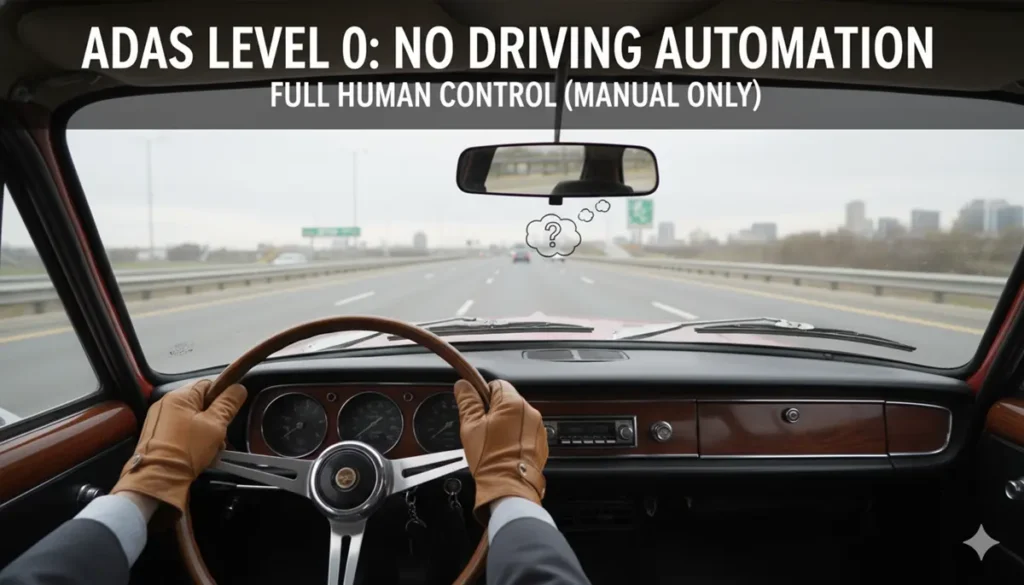
Most older cars and many budget models today still fall into this category. If your car doesn’t have adaptive cruise control, lane-keeping, or automatic emergency braking, you’re driving a Level 0 vehicle.
Real-World Example: Base variants of cars like the Maruti Suzuki Alto, Renault Kwid, or older Honda City models without any advanced safety tech.
ADAS Level 1: Driver Assistance
Level 1 is where things start getting interesting. At this level, your car can control either steering or speed, but not both at the same time. You’re still responsible for everything else.
Common Level 1 features include adaptive cruise control, which maintains a set speed and distance from the car ahead, or lane-keeping assist, which gently nudges your steering to keep you centered in your lane. These features work independently, not together.
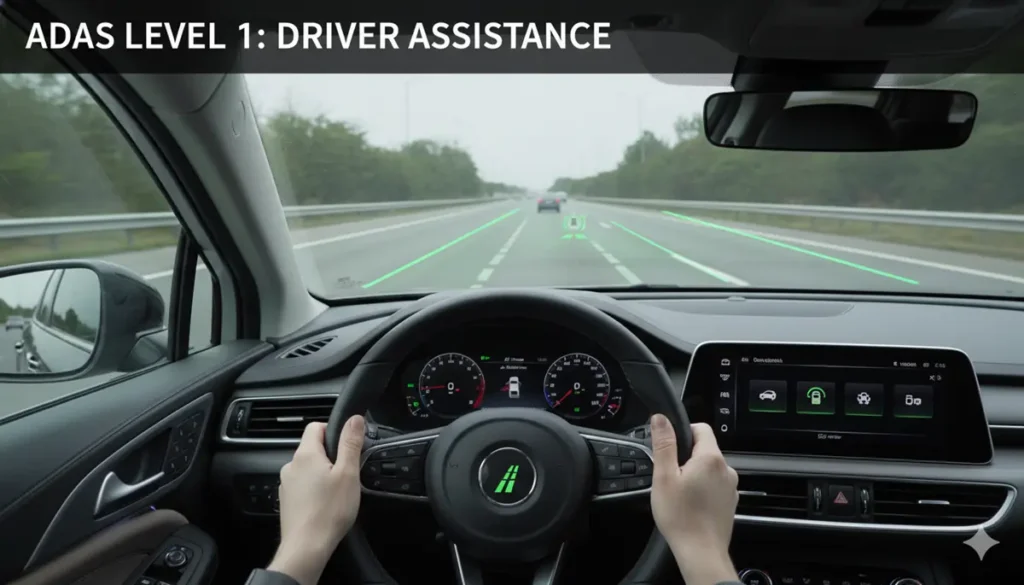
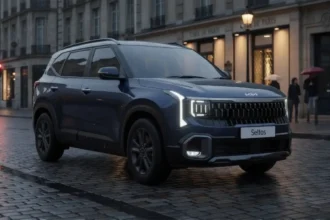
Real-World Example: Many mid-range sedans and SUVs in India offer Level 1 ADAS. The Hyundai Creta, Kia Seltos base ADAS variants, and MG Hector fall into this category. Globally, older Tesla Model S versions with basic Autopilot also started here.
Did You Know? Lane-keeping assist was first introduced by Nissan in 2001, but it took nearly two decades for the tech to become mainstream in affordable cars.
ADAS Level 2: Partial Automation
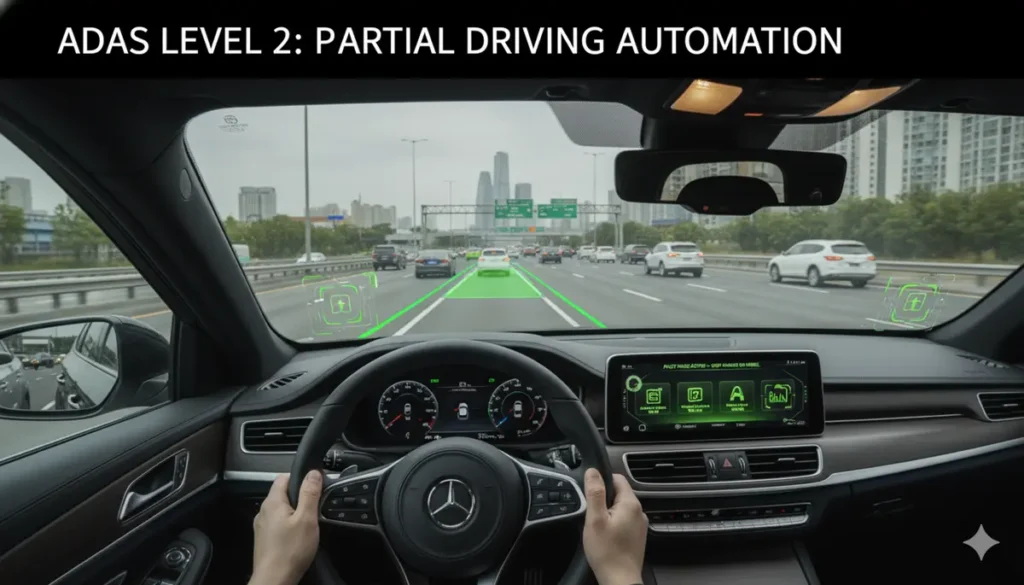
Now we’re talking. Level 2 is where your car can control both steering and speed simultaneously under certain conditions. This is the sweet spot for most modern cars today, and it’s what people usually mean when they say their car has ADAS.


With Level 2, features like adaptive cruise control and lane-centering work together. Your car can stay in its lane, maintain speed, and even brake or accelerate in traffic. But here’s the catch, you must keep your hands on the wheel and stay alert. You’re still the driver, and you’re legally responsible for everything the car does.
Real-World Example: This is where the Indian market is booming. The Honda Amaze starts at just ₹7.41 lakh and offers Level 2 ADAS with features like adaptive cruise control, lane-keeping assist, and automatic emergency braking. The Mahindra XUV 3XO is priced around ₹9 lakh, Hyundai Venue at ₹10.89 lakh, and premium models like the Hyundai Creta, Mahindra XUV700, and MG Hector Plus all offer Level 2 systems.
Globally, Tesla’s Autopilot, Mercedes-Benz Driver Assistance Package, BMW’s Driving Assistant Pro, and most new cars from Volvo, Audi, and Ford also operate at Level 2.
Level 2 ADAS adoption in India grew by 70.8 percent in 2024, making it the fastest-growing safety tech segment. I’ve tested several Level 2 systems, and while they’re impressive, you can’t zone out. The car will remind you to keep your hands on the wheel every few seconds.
ADAS Level 3: Conditional Automation
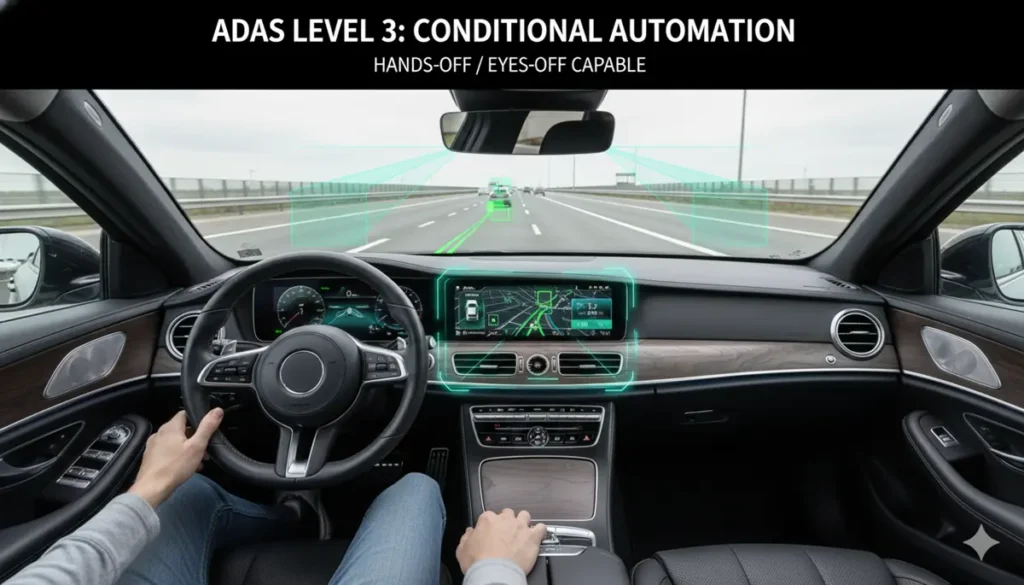
Level 3 is where things get futuristic. At this level, the car can handle all driving tasks under specific conditions, like highway driving or slow traffic, and you can actually take your eyes off the road. Yes, you read that right. You can watch a video, check your phone, or relax while the car drives itself.



But there’s a big condition. When the system reaches its limit, like entering a construction zone or bad weather, it will alert you to take over. You need to be ready to resume control within a few seconds.
Real-World Example: Mercedes-Benz Drive Pilot is the world’s first and only certified Level 3 system available to consumers. It’s approved in Germany and in California and Nevada in the US. The system works on specific highways at speeds up to 40 mph (about 64 km/h) in heavy traffic. It costs around $2,500 as an add-on for the S-Class and EQS models.
Honda also offers Level 3 technology in Japan with its Legend sedan, but it’s not widely available elsewhere. BMW and Audi have tested Level 3 systems, but they haven’t launched them commercially yet.
Level 3 is rare because the legal and liability issues are complex. If the car is driving and something goes wrong, who’s at fault? That’s why most automakers are sticking with Level 2 for now.
ADAS Level 4: High Automation
Level 4 is where the car can drive itself completely in defined areas or conditions, and you don’t need to intervene at all. Think of robotaxis operating in a specific city or autonomous shuttles on a university campus. If the system encounters something it can’t handle, it will pull over safely instead of asking you to take over.


The key difference between Level 4 and Level 3 is that Level 4 doesn’t require a human driver to be ready to take control. You could theoretically take a nap or read a book.
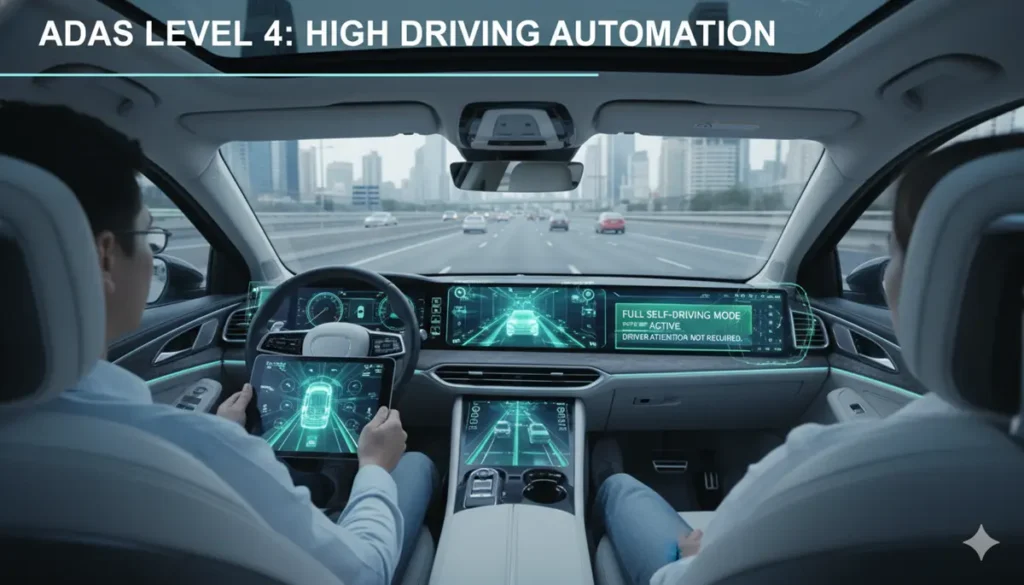
Real-World Example: Waymo operates Level 4 robotaxis in Phoenix, San Francisco, and Los Angeles. These cars drive passengers around without a human driver behind the wheel. GM’s Cruise was testing Level 4 vehicles in San Francisco, though they paused operations after some incidents. In China, companies like Baidu and AutoX are running Level 4 taxi services in select cities.
Level 4 vehicles are not available for personal purchase yet. They’re mostly used in controlled commercial settings.
ADAS Level 5: Full Automation
Level 5 is the ultimate dream. A Level 5 car can drive itself anywhere, anytime, in any condition, with zero human input. No steering wheel, no pedals, just tell the car where to go and relax. It’s what sci-fi movies promised us.
The reality? Level 5 doesn’t exist yet, and it might not for a long time. The technical, regulatory, and ethical challenges are massive. How does a car navigate a chaotic Indian traffic intersection with cows, bikes, and pedestrians? What happens in a snowstorm with no lane markings? These are problems Level 5 needs to solve.


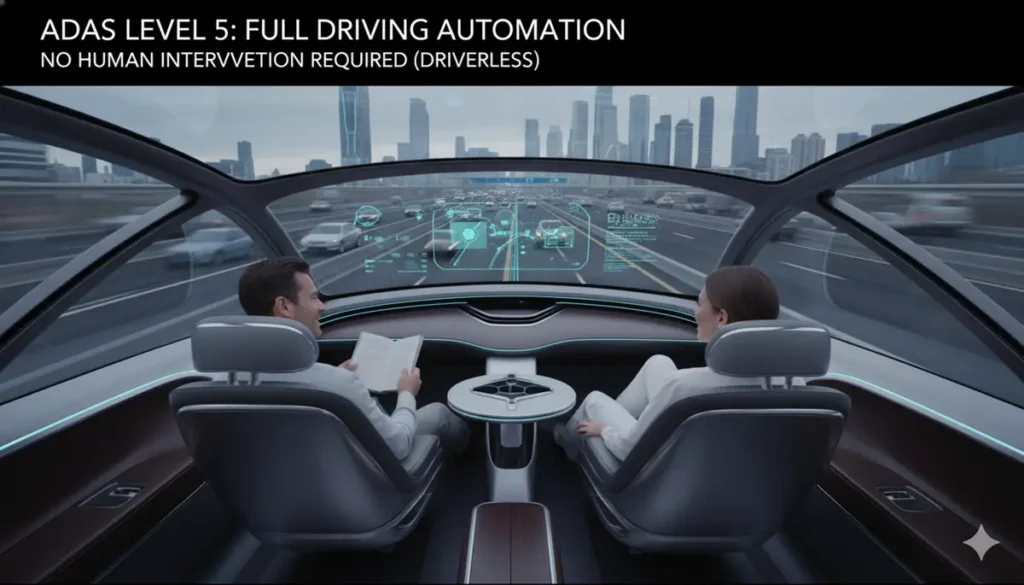
Real-World Example: None. No car on the market today is Level 5. Companies like Tesla, Waymo, and others are working toward it, but we’re still years, maybe decades, away.
Real-World Examples of ADAS in Cars Today
Let’s talk about what you can actually buy right now, especially if you’re shopping in India or other mixed markets.
Affordable ADAS Cars in India
India’s ADAS market exploded in 2024, and the options are better than ever. If you’re looking for Level 2 ADAS without breaking the bank, here are the top picks.
Honda Amaze – Starting at ₹7.41 lakh, the Amaze is the most affordable Level 2 ADAS car in India. It offers adaptive cruise control, lane-keeping assist, automatic emergency braking, and more. I’ve driven it on the highway, and the lane-centering works surprisingly well for the price.
Mahindra XUV 3XO – Priced around ₹9 lakh, this compact SUV offers a full suite of Level 2 features, including forward collision warning, blind-spot detection, and rear cross-traffic alert.
Hyundai Venue – Starting at ₹10.89 lakh, the Venue brings Hyundai’s SmartSense ADAS to the compact SUV segment.
Hyundai Creta – Around ₹13 lakh, the Creta is one of the best-selling SUVs with Level 2 ADAS in India.
Mahindra XUV700 – Priced around ₹14-15 lakh, this SUV offers one of the most comprehensive ADAS suites in India, including adaptive cruise control with stop-and-go, lane-centering, and automatic emergency braking.
Global Level 3 Pioneers
If you’re in the US or Europe, Mercedes-Benz Drive Pilot is the only certified Level 3 system you can buy. It’s expensive at $2,500 extra, and it only works on approved highways in slow traffic, but it’s a glimpse into the future.
Honda’s Legend in Japan also offers Level 3, but it’s not available in most markets.
Level 4 Testing Vehicles
Waymo’s robotaxis are the most advanced Level 4 vehicles you can experience today. If you’re in Phoenix, San Francisco, or LA, you can book a ride and see Level 4 automation in action. It’s surreal to sit in a car with no driver.
How to Check Your Car’s ADAS Level
So, how do you figure out what level your car has? Here’s a quick checklist.
Check your owner’s manual – It should list all ADAS features and how they work.
Look for these features:
- Adaptive cruise control only = Level 1
- Adaptive cruise control + lane-keeping working together = Level 2
- Hands-off, eyes-off capability in specific conditions = Level 3
- No driver needed in defined areas = Level 4
- No driver needed anywhere = Level 5 (doesn’t exist yet)
Test it safely – On an empty highway, activate your adaptive cruise control and lane-keeping. If the car stays centered in the lane and adjusts speed automatically, you’ve got Level 2.
Ask your dealer – Most salespeople don’t know the technical levels, but they can tell you what features your car has. You can map those features to the levels yourself.
Most cars sold today are Level 0, 1, or 2. If you’ve got Level 3, you’re driving something very rare and expensive.
Also Read: Why Everyone Calls Tata Sierra the Mini Defender?
The Technology Behind ADAS
Sensors and Hardware
ADAS systems rely on a combination of sensors to see the world around your car.
Cameras – These are the most common sensors. They can read road signs, detect lane markings, and identify pedestrians. Most Level 2 systems use multiple cameras placed around the car.
Radar – Radar sensors measure distance and speed. They’re great for adaptive cruise control because they work in all weather conditions, even rain and fog.
Ultrasonic Sensors – These are used for parking assist and low-speed maneuvers. They detect objects very close to the car.
LiDAR – Light Detection and Ranging uses laser beams to create a 3D map of the surroundings. It’s more accurate than radar or cameras, but also more expensive. Level 4 systems like Waymo rely heavily on LiDAR.
Most affordable ADAS cars in India use cameras and radar. LiDAR is reserved for high-end autonomous vehicles.
Software and AI
The hardware is only half the story. The real magic happens in the software. ADAS systems use artificial intelligence and machine learning to process sensor data in real-time and make decisions.
For example, when your car’s automatic emergency braking detects a pedestrian, the AI identifies the object, calculates the collision risk, and triggers the brakes, all in milliseconds. The more data these systems collect, the smarter they get.
Companies like Tesla, Waymo, and Mercedes are constantly updating their ADAS software through over-the-air updates, improving performance without you needing to visit a service center.
ADAS Adoption and Market Trends
The ADAS market is exploding globally. In India, adoption jumped to 8.3 percent in early 2025, with Level 2 systems seeing 70.8 percent growth in 2024. Affordable models like the Honda Amaze and Mahindra XUV 3XO are making ADAS accessible to middle-class buyers.
Globally, the ADAS market is expected to reach $65 billion to $83 billion by 2027 to 2030, depending on which research firm you ask. Europe and the US are leading adoption, but Asia, especially India and China, is catching up fast.
Governments are also pushing for ADAS. The European Union mandates automatic emergency braking and lane-keeping assist on all new cars. India’s Bharat NCAP is encouraging automakers to include ADAS features to achieve higher safety ratings.
Did You Know? By 2030, experts predict that nearly 60 percent of new cars sold globally will have Level 2 ADAS or higher.
Future of ADAS Technology
Where is ADAS headed? Here’s what I see coming.
More affordable Level 2 systems – As technology gets cheaper, even entry-level hatchbacks will offer ADAS. We’re already seeing this trend in India with the Honda Amaze.
Level 3 expansion – Mercedes is just the beginning. Expect BMW, Audi, and Tesla to launch Level 3 systems in the next few years, especially in Europe and the US.
Level 4 robotaxis – Companies like Waymo and Cruise will expand their Level 4 services to more cities. You might not own a Level 4 car, but you’ll be able to hail one.
Vehicle-to-Everything (V2X) communication – Future ADAS systems will talk to traffic lights, other cars, and infrastructure to make smarter decisions. This tech is already being tested in China and Europe.
Regulatory clarity – Governments need to figure out liability and insurance rules for Level 3 and above. Until then, adoption will be slow.
Level 5 full automation? That’s still a long way off. The technology needs to handle every possible scenario, from rural dirt roads to chaotic urban intersections. I wouldn’t hold my breath for Level 5 in the next decade.
FAQs on ADAS Levels 0 to 5
What is the difference between Level 2 and Level 3 ADAS?
Level 2 requires you to keep your hands on the wheel and eyes on the road at all times, even though the car controls steering and speed. Level 3 allows you to take your eyes off the road in specific conditions, but you must be ready to take over when the system asks.
Can I buy a Level 3 ADAS car in India?
No, Level 3 ADAS is not available in India yet. The most advanced systems in India are Level 2, found in cars like the Honda Amaze, Mahindra XUV700, and Hyundai Creta.
Is ADAS worth the extra cost?
If you drive frequently on highways or in heavy traffic, ADAS is absolutely worth it. Features like adaptive cruise control and automatic emergency braking reduce fatigue and improve safety. However, if you mostly drive in the city at low speeds, you might not use these features as much.
Does ADAS work in bad weather?
It depends. Radar sensors work well in rain and fog, but cameras can struggle. In heavy rain or snow, some ADAS features like lane-keeping might disable themselves temporarily. Always stay alert and ready to take control.
Will ADAS increase my car insurance premium?
Actually, the opposite is often true. Many insurance companies offer discounts for cars with ADAS because they’re statistically safer. However, repair costs can be higher if ADAS sensors are damaged.
When will Level 5 fully autonomous cars be available?
Nobody knows for sure. Experts estimate it could take another 10 to 20 years before Level 5 cars are commercially available. The technology, regulations, and infrastructure all need to catch up.
Final Thoughts
So, which ADAS level does your car really have? If you’re driving a modern car from the last few years, chances are it’s Level 1 or Level 2. If you’re in a Mercedes S-Class with Drive Pilot in California or Germany, congratulations, you’ve got Level 3. And if you’re in a Waymo robotaxi, you’re experiencing Level 4.
Understanding ADAS Levels 0 to 5 isn’t just about knowing fancy terms. It’s about knowing what your car can and can’t do, so you stay safe and make informed buying decisions. Level 2 is the sweet spot for most buyers today, offering real safety benefits without the sky-high costs of Level 3 or the unavailability of Level 4 and 5.
If you’re shopping for a new car, prioritize ADAS features. They’re not just nice-to-haves anymore, they’re becoming essential. Whether you’re in India looking at the Honda Amaze or in the US considering a Tesla, ADAS is one of the best investments you can make for your safety.
What ADAS level does your car have? Have you noticed these features making a difference in your daily driving? Drop a comment and let me know your experience. I’d love to hear whether you trust your car’s ADAS or if you’ve had any close calls.